
Stoplights
August 19, 2026
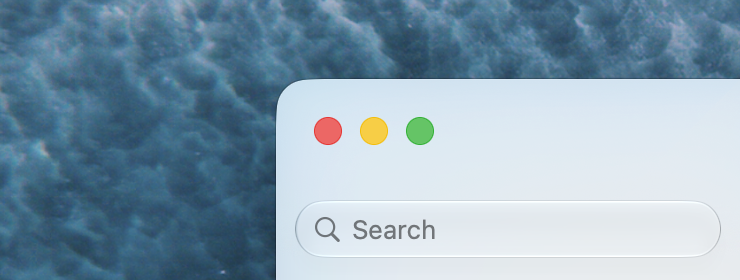
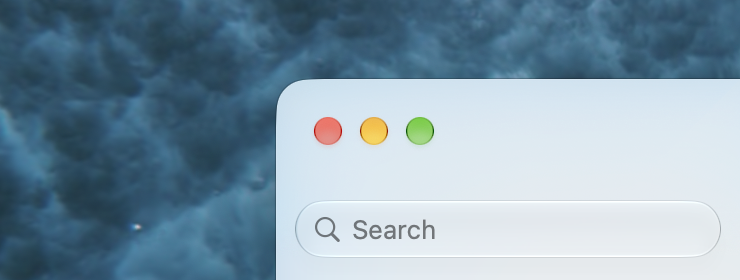
Twelve years ago, Mac OS X Yosemite stomped the aqua out of the stoplight buttons, leaving us with the flattened circles we see today. Until this week’s Golden Gate beta, of course!
Read More →
Liquid Glass 2.0 in CSS
🔗 thathtml.blog • August 4, 2026
I’m not sure folks are appreciating just how different this new version is. The changes may appear subtle at first, but they’re in fact quite profound—and they reflect a direction I’d hoped Apple would take all along: the resurrection of Aqua.
Great blog post on the differences between Liquid Glass 1.0 and 2.0, as well as a re-creation of the glass effect in the browser. Fun!
Sidebar Animation Jank
July 29, 2026
I desperately want to see more native, SwiftUI apps on the Mac. But sometimes I feel like web apps beat Apple on fit and finish. Take this sidebar animation as an example. Codex, a web-based app, nails it:
Read More →
Go to Squircle Jail!
July 28, 2026
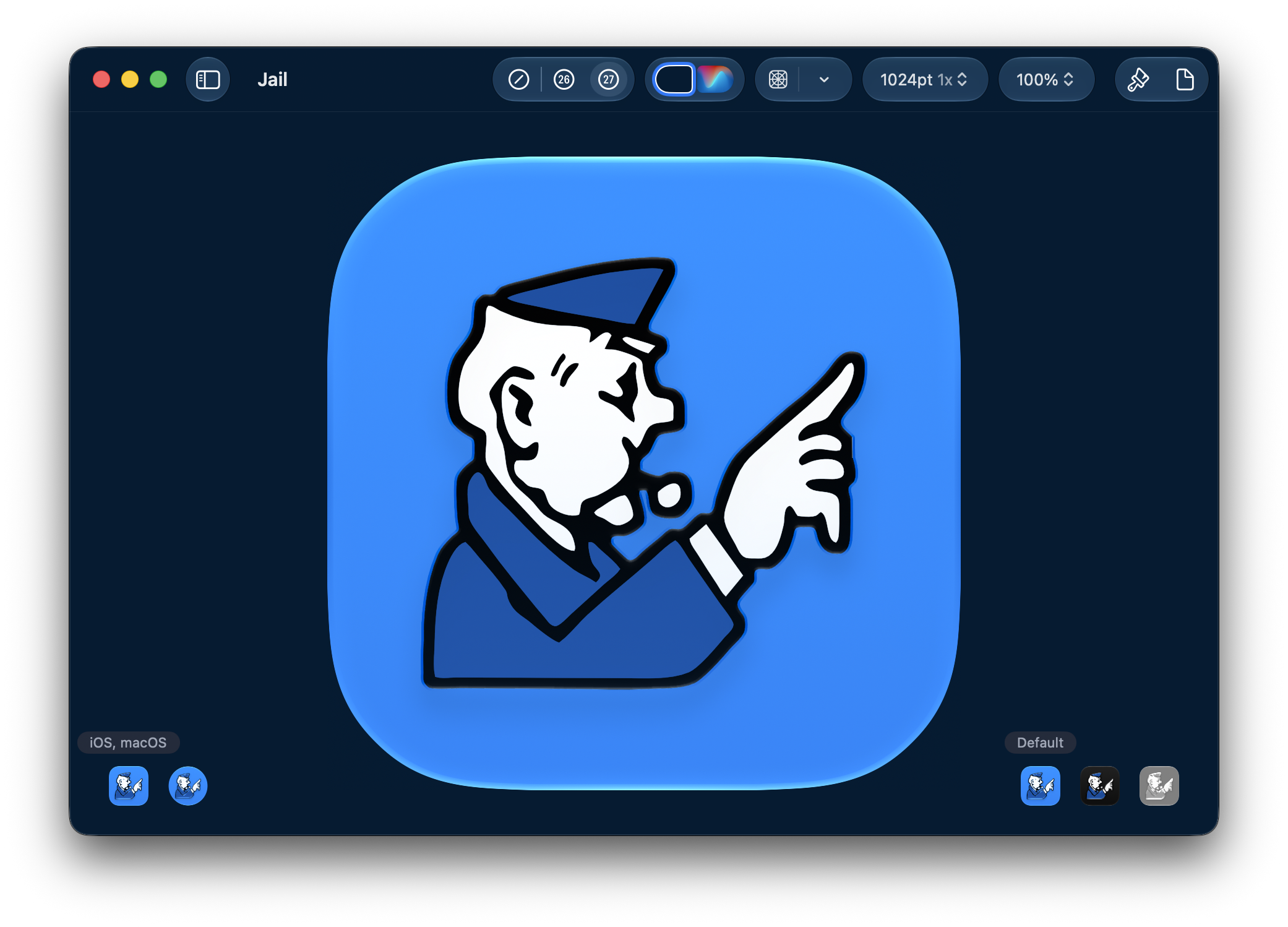
I really really like Louie Mantia's recent essay, 'The Shape of Apps'. It addresses Apple's recent changes to app icons on the Mac, most notably the introduction of squircle jail. Unlike a lot of the banal complaining I see on social media, the essay is thoughtful and attempts to punch at the other side of the debate: what are we gaining with these changes that people aren't seeing?
It's by far the best piece of commentary on the topic. The point of this post isn't to rehash it. Instead, I want to take one of Louie's points and push it even further:
The reality we all witnessed over the last almost-20 years is one where our macOS Dock had a few apps that were not developed by some indie developer who cared. The apps we didn’t want to use—but had to for one reason or another—looked very out of place.
Read More →
WWDC 2026: Between Seasons
🔗 macstories.net • June 11, 2026
Perhaps it’s not the most poetic image, me having a deep realization about my career and the company I write about as I’m staring at the back of two men’s heads. Whenever you’re lucky enough to find it, you have to receive life’s poetry – even when, and especially if, it makes for a funny story to tell. That moment encapsulated the energy I would feel for the rest of the conference.
What’s an iPad?
April 30, 2026
Craig Mod, in a recent essay:
Your hands should be swooping and swiping and the whole OS should feel like skipping across a taut slackline, a bit bouncy and pleasing and physical but also precise and quick and focused taking you where you need to go, across some creative gulf. There should be no “hard edges” anywhere. iPadOS shouldn’t be anything like Windows or macOS or Linux, it shouldn’t be iOS made big, it should be only like iPadOS — a singular thing of finger-poking joy.
The iPad, as Apple’s most versatile product, has always felt a bit lost in the wilderness with its identity. Years ago, prior to the Mac’s transition to Apple Silicon, I adored the idea of the iPad supplanting the Mac as the one true computer. Many did.
Read More →
Journey to the Moon
🔗 nasa.gov • April 6, 2026
NASA’s Artemis II mission has been fruitful in producing stunning and inspiring images, to say the least. The linked gallery appears to be what has been shared with us thus far. With luck, we’ll soon see the “earthset” images shot today, as the crew meandered their way around the dark side of the moon.
Also interesting is their choice in cameras. It looks like they have a few Nikon D5s on board, as well as the iPhone 17 Pro (in "space silver", of course). Many gallery images from the Nikons are 1920x1280px JPEGs, which leads me to believe these aren't really full resolution. I'd love nothing more than to get the full .NEF RAW files – maybe once they land back on Earth!
I'm also dying to know – if they are shooting RAW on the Nikons (they must be, right?) then are they shooting Apple ProRAW on the iPhones?
Update, 4/7/26: The "earthset" images have been published to a separate gallery here, and they. are. incredible.
Fifty Years of Apple
April 1, 2026
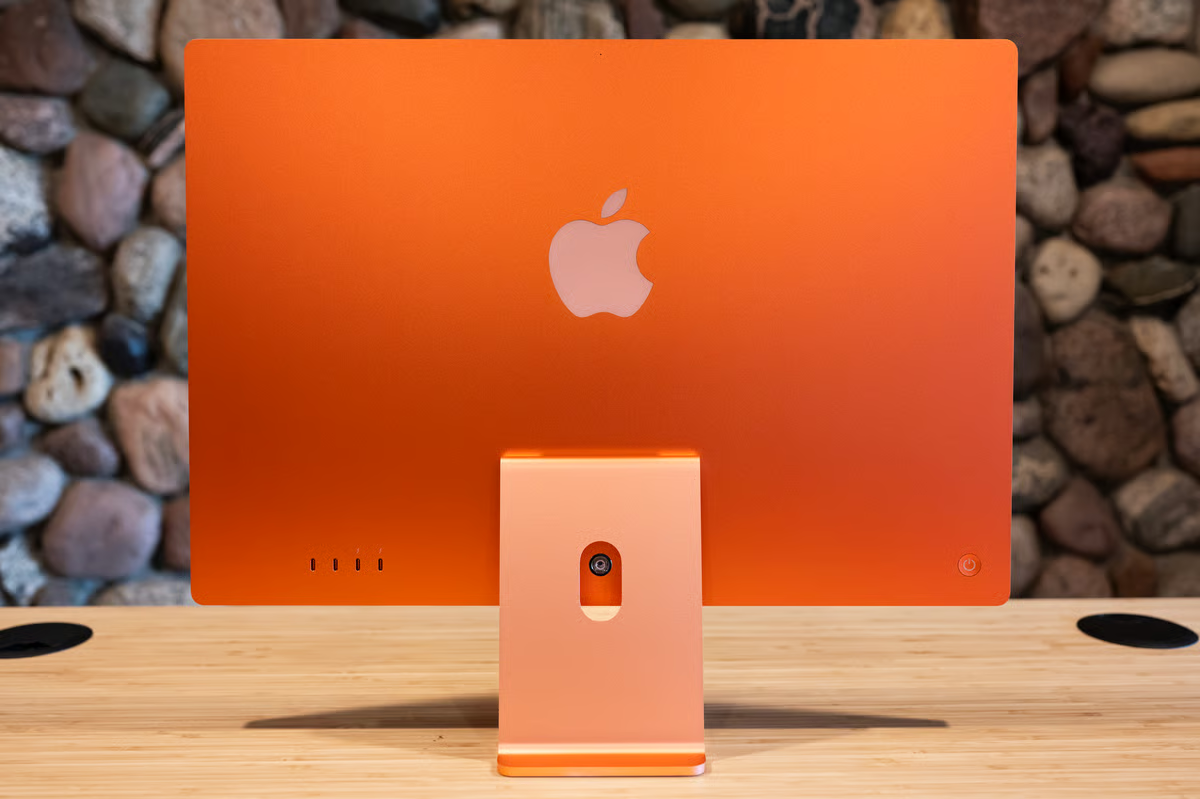
I love reading the personal anecdotes that have been written in light of Apple’s 50th anniversary today — like this one from Parker Ortolani. Adding to the pile, I wrote this on Bluesky:
I’ll never forget when, as a kid, our PC at home died – and I persuaded my parents to get a Mac mini. At the time, I had no idea that would set the trajectory for my career in software / lifelong interest in the Mac.
Read More →
One Year
March 22, 2026
My kid turned one year old this month.
Not only did we survive the first year, we bought a house, uprooted our lives, and I landed my dream job while juggling the role of newborn dad.
Read More →
“This Is Not The Computer For You”
🔗 samhenri.gold • March 15, 2026
Sam Henri Gold, in a fantastic essay in context of the MacBook Neo launch:
Obsession works by taking whatever is available and pressing on it until it either breaks or reveals something. The machine’s limits become a map of the territory. You learn what computing actually costs by paying too much of it on hardware that can barely afford it.
The Window Chrome of Our Discontent
🔗 pxlnv.com • March 6, 2026
Even if you don't read the post, just scroll through the screenshots on Nick Heer's recent blog post showcasing the changes to Apple Pages from Mac OS X Lion, all the way to macOS Tahoe.
I don't need to add any commentary – Nick's post is comprehensive. The decline in clarity and usability is staggering.
More Software
🔗 x.com • March 3, 2026
Kenton Varda on Twitter:
Worries that software developer jobs are going away are backwards. There is SO MUCH software to build right now, that previously wasn't possible (uses AI directly) or wasn't cost-effective (too niche). We're going to have more developers, and orders of magnitude more software.
It’s hard to see if you live in a tech bubble like myself, but much of the world runs on shitty, glued-together systems (if they have software at all).
Where is the bespoke app that helps someone start and run a childcare business out of their own home? What about the tire shop down the road — is there something that could solve their problems that doesn’t exist?
In light of AI efficiencies, some companies may choose to become more lean. The industry may certainly restructure. But I agree with Kenton — the net result will simply be more software, and in places that it has never been before.
And nobody is better at creating software with AI tools than software engineers.
Autonomy in 2030
December 23, 2025
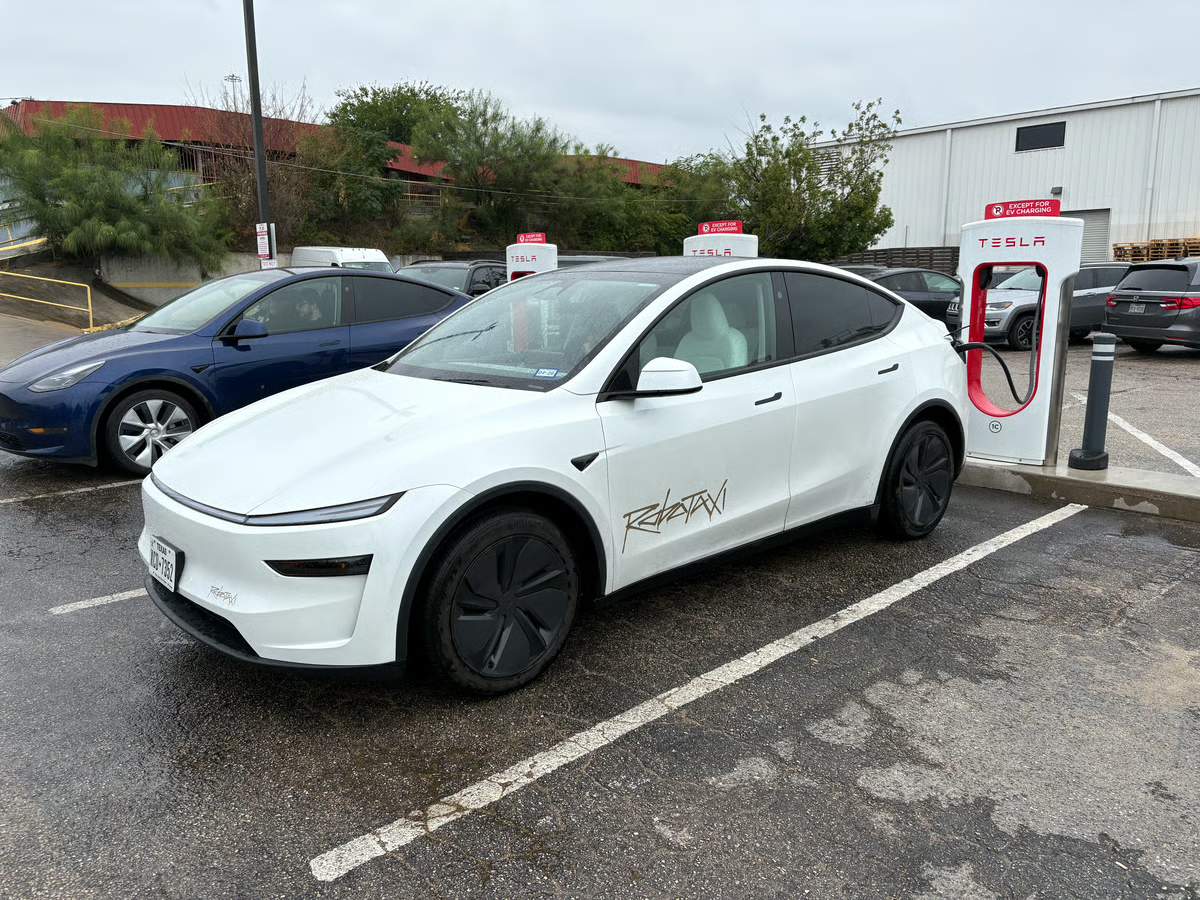
If you've spoken with me for more than eight seconds, you may know I'm unable to shut up about Waymo and self-driving cars. Earlier this year, Waymo ran its service in Austin as an invite-only program before opening to the public. During this time, I logged 62 rides, 355 miles, and 1,363 minutes of Waymo-ing around town!
Autonomous vehicles (AVs) are exciting to me – I see the remarkable potential they have. While I have no actual industry experience with the technology (my knowledge is that of a fanboy), I thought it would be fun to lob a thoughts about the future into the abyss of the internet.
Specifically, I'd like to predict what the state of autonomy will look like by the end of 2030. If I'm right, you’ll see me gloat on Bluesky or something. If I'm horribly wrong, this webpage will 404.
I'd like to start with one of the more contentious issues: cameras versus lidar.
Read More →
Physicality: the new age of UI
🔗 lux.camera • June 3, 2025
Sebastian's concepts for Apple's rumored OS redesign feel spot on. I'm curious how this will play out on macOS, where most modern software is merely a web wrapper. As a fan of 'Mac-assed Mac apps', I hope this redesign elevates apps that adopt the platform's UI, making web wrappers feel clunky and dated.
Edit: Looks like Gruber has a similar take.
Becoming a Father #2: Conversation
April 29, 2025
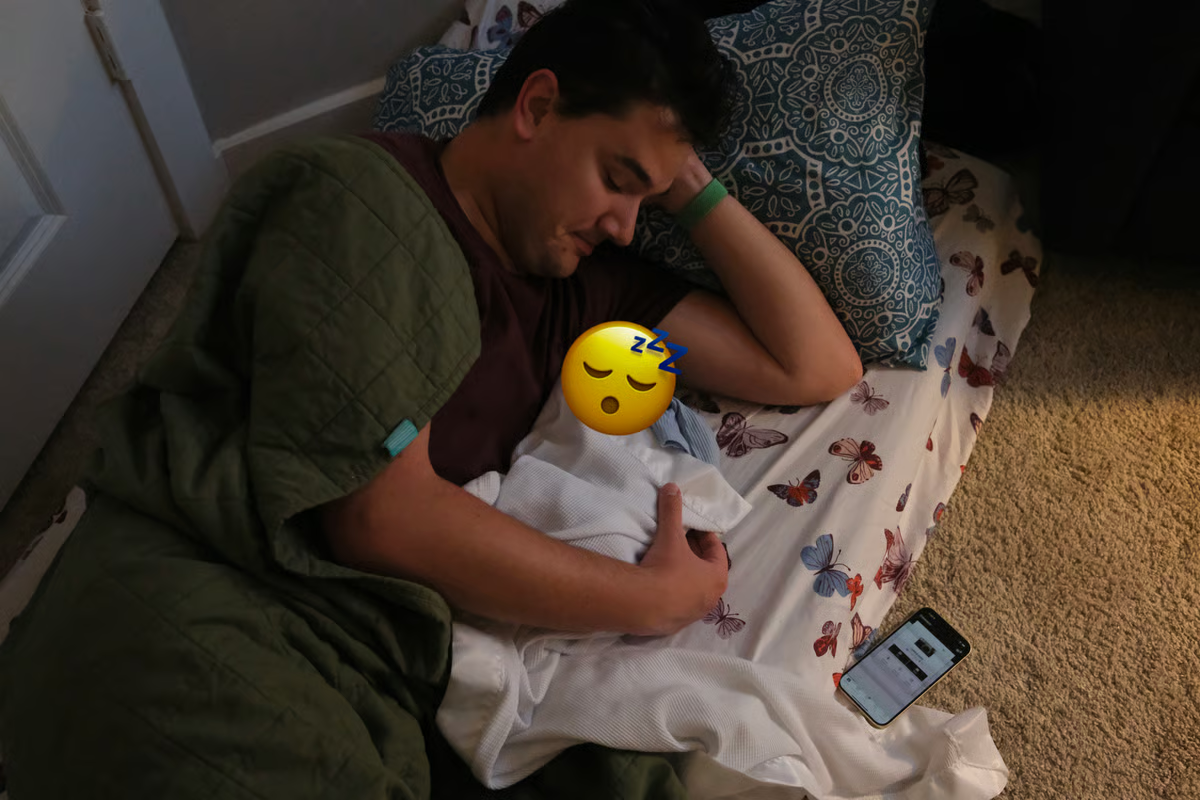
The day after my birthday, ‘A’ and I were sitting on the floor of the nursery late. (It was 8pm, which is considered late now.) I was using my leg in a V-shape to hold him upright, his head near my knee.
His eyes fixated on me, in a strange and unusual way. I tried what I had been for weeks at this point: making faces, sounds, and clowning around in attempt to get even the smallest reaction out of him.
The first few weeks of this felt like a comedy routine performed to an audience of bricks. (Screaming bricks, specifically.) While ‘A’ has become more expressive capable of eye contact over time, there still hasn’t been a clear “call and response” between him and I.
Read More →
Becoming a Father #1: Day and Night
March 16, 2025
Preface: Last week, my wife (Cassidy) and I became parents! While I plan on writing more extensively about our time at the hospital, this series is intended to process stray thoughts and memories as they happen.
Here are a few notes from our first few days home with our son, who I refer to as ‘A’. (Perhaps we'll call the second and third ‘B’ and ‘C’?)
Read More →
Why We’re Bringing Pebble Back
🔗 ericmigi.com • January 28, 2025
The Pebble was my first smart watch. I purchased a the original model in jet black not long after release. I was in high school at the time, and I recall it drawing a bit of attention at the summer camp I worked at. Maybe it was my age, but I certainly felt dorky wearing it!
Now, in 2025, you wouldn’t glance twice.
I had really, really, really hoped that someone else would come along and build a Pebble replacement. But no one has. So… a small team and I are diving back into the world of hardware to bring Pebble back!
I’m thrilled it’s making a comeback. A hackable, affordable e-ink watch? I don’t care how dorky it looks.
The emphasis is on sustainability. I want to keep making cool gadgets and keep Pebble going long into the future.
This is the right idea.
Have Kids
🔗 writing.nikunjk.com • January 23, 2025
You think you understand love before kids. You don't. Every other relationship comes with implicit conditions. Partners choose each other daily. Parents love you deeply, but there's history. With your child? It's different. It's a love so fundamental it becomes part of your operating system.
The hard truth: Americans don’t trust the news media
🔗 washingtonpost.com • October 29, 2024
Most people believe the media is biased. Anyone who doesn’t see this is paying scant attention to reality, and those who fight reality lose. Reality is an undefeated champion.
Newspaper endorsements never made sense to me – especially in a low-trust environment. Shouldn't a publication's aim be to build credibility with readers? I agree with Bezos: a failure to build trust will drive people further into social media and podcasts, where standards for news and journalism can be near-zero.
Camera Roll: Formula One Day
October 22, 2024
Sunday was Formula One day in Austin, Texas. The infrastructure to move 400k people to-and-from a suburban race track is enormous! Pictured is one of the (hundreds) of buses leaving, after dropping us off back at our parking lot on the north side of the city.
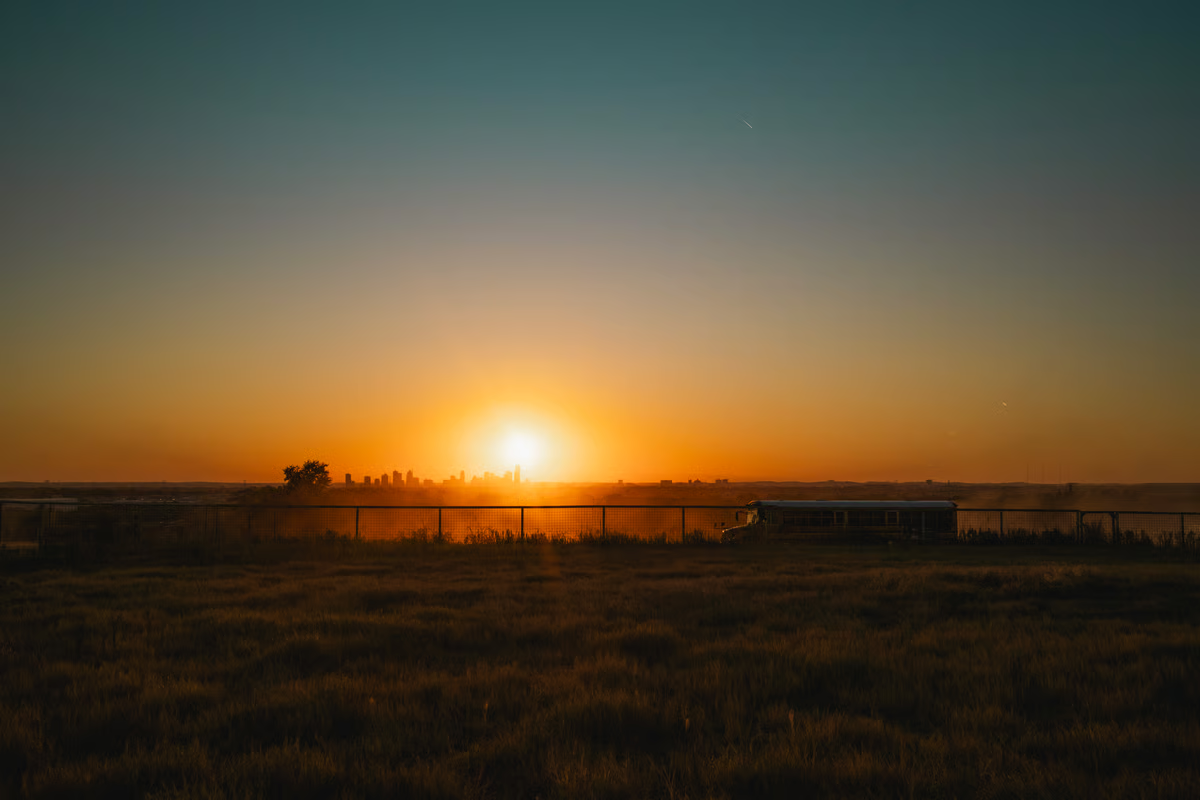
View this photo on Glass.