Predictions for Autonomy in 2030
December 23, 2025
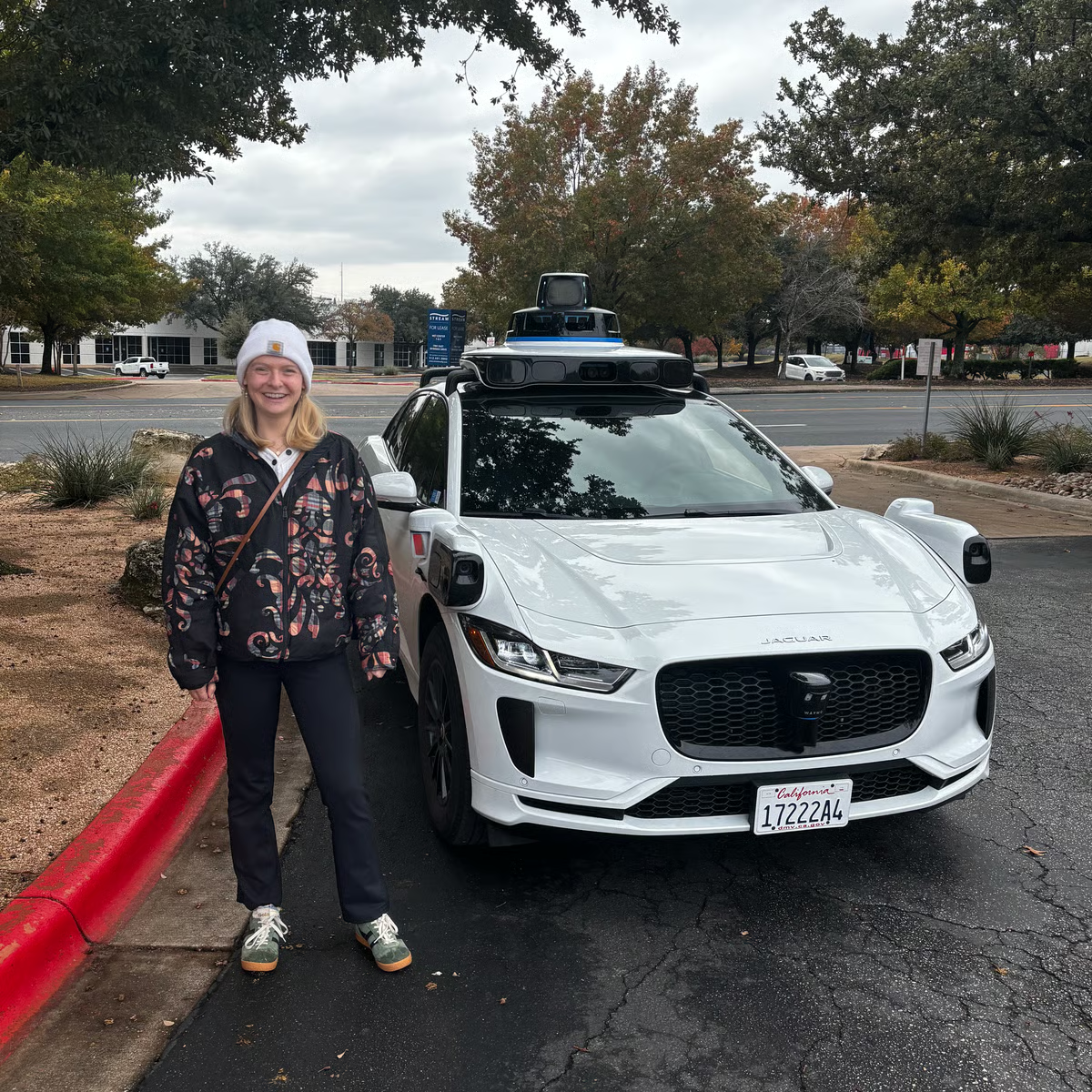
If you've spoken with me for more than eight seconds, you may know I'm unable to shut up about Waymo and self-driving cars. Earlier this year, Waymo ran its service in Austin as an invite-only program before opening to the public. During this time, I logged 62 rides, 355 miles, and 1,363 minutes of Waymo-ing around town!
Autonomous vehicles (AVs) are exciting to me – I see the remarkable potential they have. While I have no actual industry experience with the technology (my knowledge is that of a fanboy), I thought it would be fun to lob a few predictions about the future into the abyss of the internet.
Specifically, I'd like to predict what the state of autonomy will look like by the end of 2030. If I'm right, you’ll see me gloat on Bluesky or something. If I'm horribly wrong, this webpage will 404.
I'd like to start with one of the more contentious issues: cameras versus lidar.

1. Tesla will add at least two non-camera sensors to their self-driving hardware (radar or lidar)
Tesla's Full Self Driving (FSD) software operates entirely on (nine?) camera sensors positioned around the car that feed data to an impressive vision-only model. No radar, no lidar. They are the only major player taking a strict vision-only approach to autonomy.
While I believe betting on vision is the right direction, I think vision-first (not vision-only) systems will ultimately win. I have a hard time imagining a vision-only system reaching extraordinarily high safety standards we (as a society) will demand of AVs.
For mass adoption, a self-driving car cannot merely operate as well as a human. That would be a complete failure – humans are terrible drivers! Even a self-driving system that performs 2x or 10x better than a human driver will be insufficient. The bar for safety should be set remarkably high, to the point where even hardened cynics would be forced to admit the societal good of AVs.
I want to feel safe placing my nine-month-old son in the back of a self-driving car and having it road trip us from Texas to Wisconsin. That's the threshold. If you told me the car was only 2x safer than a human, I wouldn't do it. Logically, choosing the self-driving car in this scenario would be safer, but I don't think that's how human psychology works. If humans are going to give up control, they need to know it's "safe beyond your imagination", not just "a bit better than you".
I already believe Tesla's FSD is far safer than a human driver. I also believe their vision-only system may solve 99.9% of the problem. It may even be feasible to deploy and scale their robotaxi service on vision alone. But, as I've said previously, mass adoption will require a 100% solution.
Thus, I predict Tesla will need to add at least a few radars or lidars to their hardware suite before the end of 2030. I’m not sure how you can guarantee that safety otherwise.
For some odd reason, there's a cohort of Tesla influencers on social media that have religious zeal in their belief that "any self-driving system using lidar is doomed to fail". This is based on a statement Tesla's CEO made years ago.
This belief appears to be doctrine to some. What's funny to me is, I don't think Tesla themselves hold their beliefs this strongly. They're committed to making FSD work, hell or high water. If they realize they need additional sensors to make that happen, they'll pivot and do it in a heartbeat. It's that simple.
2. Waymo will announce a seventh-generation driver, which will dramatically reduce sensors
Waymo, whom I consider to be leading the pack, has taken a maximalist approach to sensors on its vehicles: 26 cameras, 6 radars, and 5 lidars.
Their sixth-generation driver (which is not widely available yet) will reduce this to 13 cameras, 6 radars, and 4 lidars.
While Tesla may have to make concessions and add sensors, it's safe to say Waymo is actively working in the other direction. Thus, I predict Waymo will announce a seventh-generation driver which will again, dramatically reduce the sensors on the vehicle.
This is a lame prediction – I know. It's like predicting the iPhone 18 will come out next September. To make it more interesting, I'm going throw down some numbers: the 7th generation driver will have 9 cameras, 4 radars, and 1 lidar.
This is based on absolutely nothing. But hey, if I'm right, wouldn't that be neat?
Side note: it's thrilling to watch two talented companies solve the same problem from opposite directions. By 2030, I think we'll have a clear victor. Living in Austin feels like being at ground zero of the AV space race.
3. Personal vehicles will drive you in limited circumstances, but they’ll still have steering wheels
I imagine, by the end of 2030, robotaxis will be abundant and available in every major and mid-sized American city, with multiple services available in each. I think traditional Uber and Lyft rideshare volume will be noticeably suffer by then.
After robotaxis, the next chasm to cross will be making AVs purchasable as personal vehicles – like the cars sitting in your driveway now.
(And to clarify – my definition of AV here is a truly driverless car, i.e., no steering wheel. Not a car with a fancy driver-assist system.)
Perhaps it will be legal to sit in the back of my Tesla and have it drive me in limited circumstances. I could see this happening! In fact, I’ll note it as an official prediction. But the dream of a fully autonomous personal vehicle with no steering wheel? Not happening, at least not by 2030.
As of now, the only announced consumer product that intends to ship without a steering wheel is Tesla's Cybercab. This prediction implies the Cybercab will either undergo significant modifications before going on sale, or never be sold as a private vehicle.
We'll have many years of "hybrid" vehicles, ones that will drive us, but will also allow us to drive them, before we reach the vision of the personally-owned Cybercab.
4. Sales for personal vehicles will not drop due to the rise of robotaxis
One minor trend I see coinciding with the rise in AVs is the idea that personally owned vehicles will largely go by the wayside.
Robotaxis will litter the country, they'll be affordable and available in droves. Why own a car!
There could be some truth to this. I'd happily offload one of my cars in favor of an affordable robotaxi subscription. But I don't think this will be the case for most people – the personal vehicle is deeply embedded in our lives and will be for at least a decade more.
5. EV minivans will be real, right?
Okay – has nothing to do with AVs. This is me using my stupid little blog to manifest EV minivans into reality.
As a new dad, a minivan is an inevitability. As an EV enthusiast, I'm salty that there are no good options (especially after Volkswagen cancelled the ID.Buzz in the United States).
And no, the R1 and EV9 won't cut it – families need sliding doors, folks! So please, Rivian, Tesla, whoever hears my plea, don't make me buy a Honda Odyssey!
And there you have it, some silly, maybe disjointed predictions! Regardless of how things turn out, I think the future looks bright. See you in 2030!